Ollama User Guide - SSH Access Version
Before You Begin
The following items must be ready before following this guide.
| Item | Description |
|---|---|
| gcube account | Sign up at gcube.ai |
| SSH terminal program | PuTTY or equivalent terminal program |
| Credit balance | GPU usage costs apply on the gcube platform (billed hourly) |
Tip
PuTTY Download: Available for free at https://www.putty.org.
Overview
What is Ollama?
Ollama is a platform that lets you download and run open-source AI language models in a local environment. This guide walks you through running Ollama on gcube's cloud GPU environment and using the Llama3 model via SSH access.
Representative AI models available in Ollama:
| Model | Developer | Features |
|---|---|---|
| Llama 3 | Meta | Excellent natural language processing |
| Phi 3 | Microsoft Research | Strong reasoning and language understanding |
| Mistral | Mistral AI | Optimized for various language tasks |
| Gemma 2 | Strong at natural language processing and generation | |
| CodeGemma | Specialized in code generation and completion |
Step 0 — Create and Log In to gcube Account
0-1. Sign Up
Go to https://gcube.ai and click the "Sign Up" button in the upper right. Complete email verification to create your account.
0-2. Log In
After signing up, log in on the same page.
0-3. Check Credits
gcube charges based on GPU usage time. Check your credit balance on the dashboard before use.
Billing Notice
Workloads are billed hourly from the time of deployment until stopped. Always stop the workload after use. Refer to Step 4 for instructions.
Step 1 — Register Workload on gcube
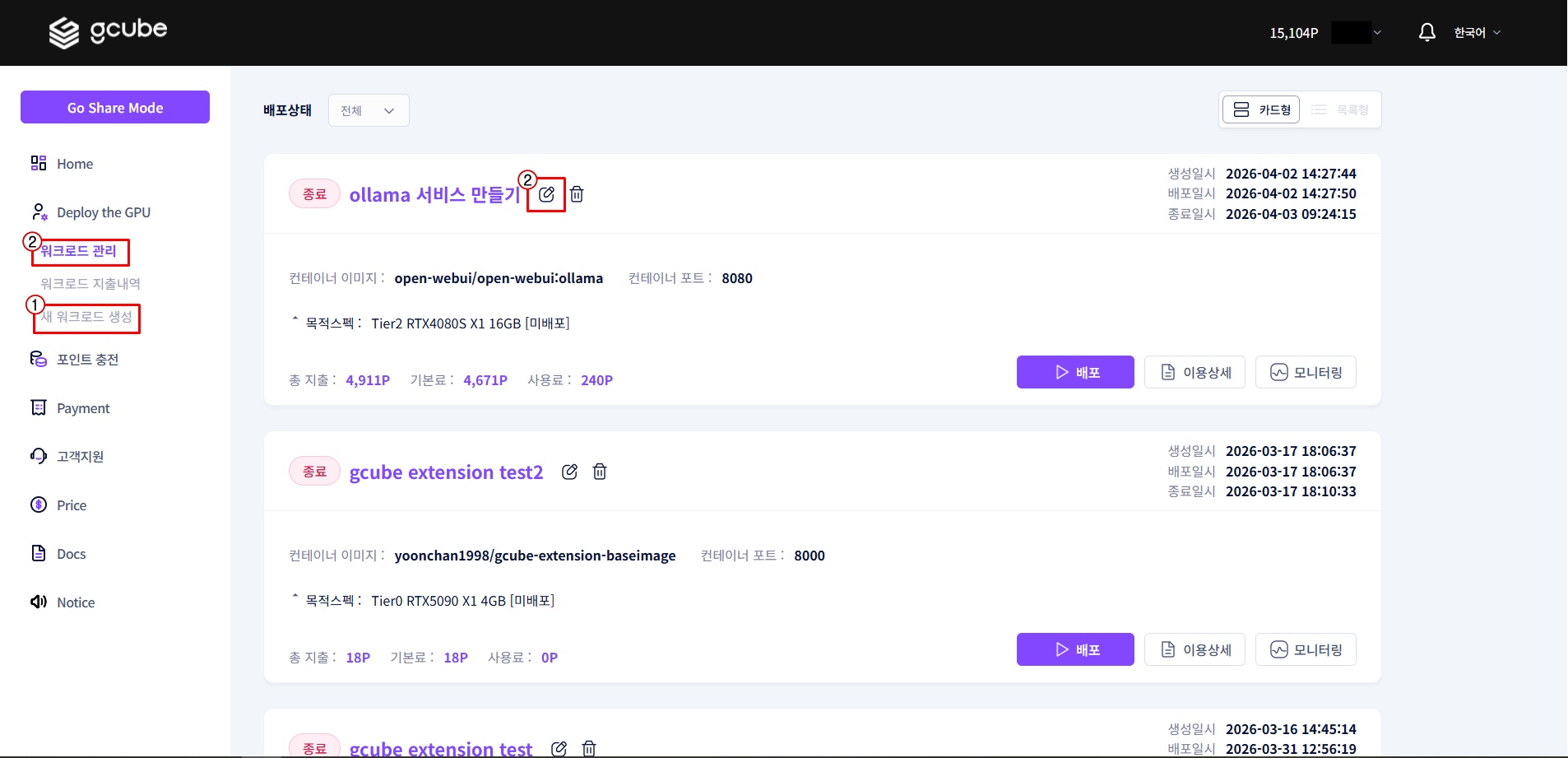
1-1. Access Workload Page
Go to https://gcube.ai/ko/demand/workload/list.
① Register a new workload or ② select an existing one to modify.
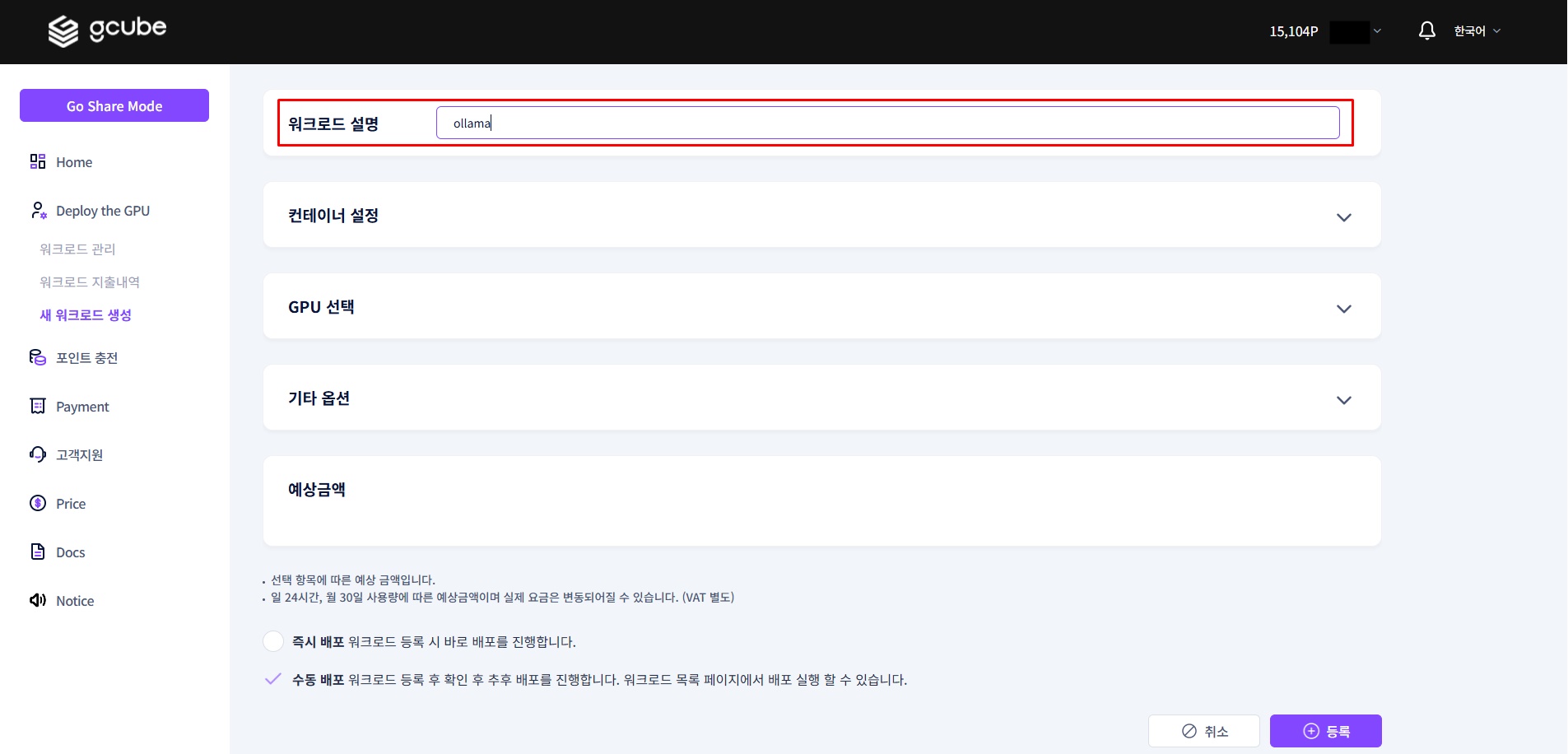
1-2. Enter Description
Enter the workload name.
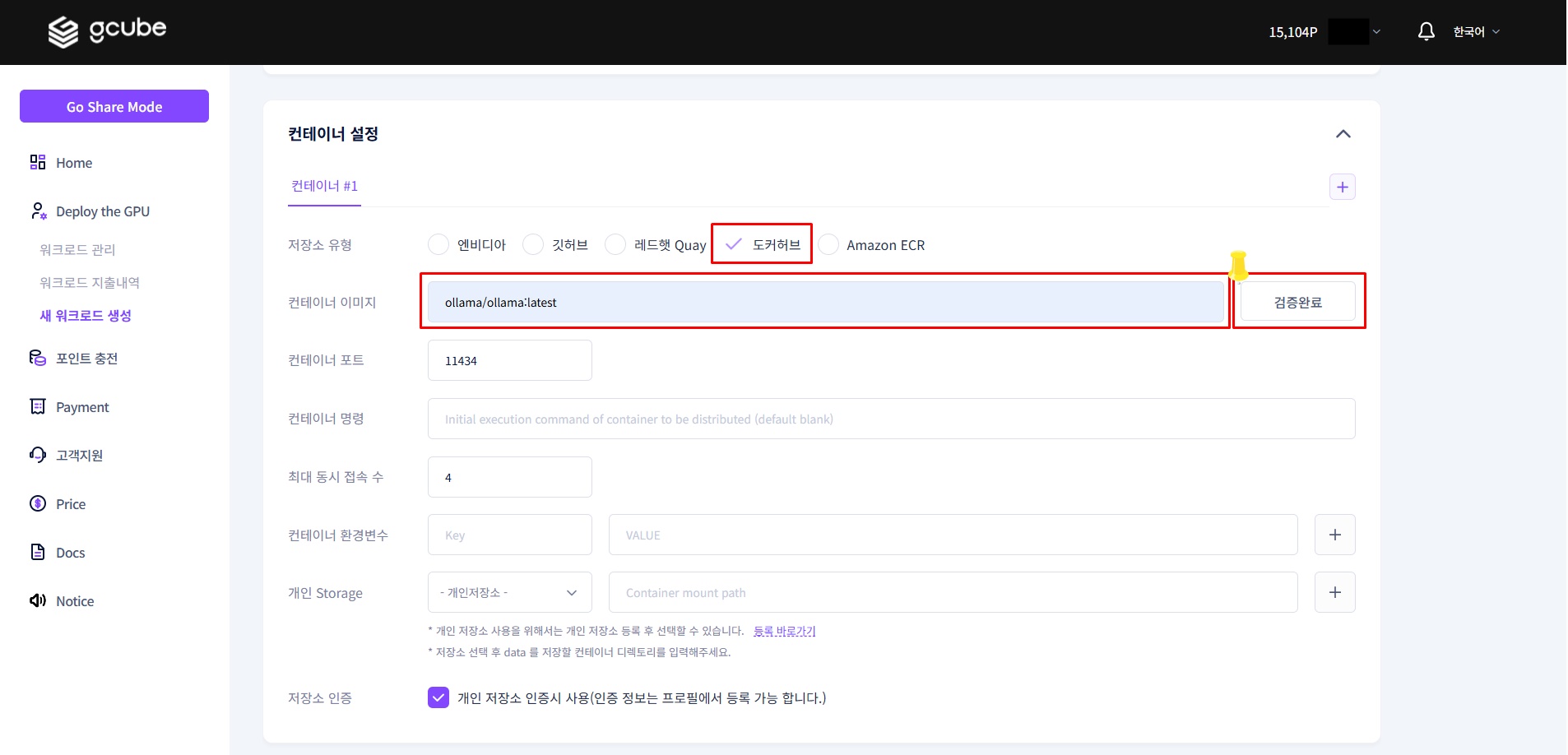
1-3. Container Settings
Enter the following in order.
| Item | Value |
|---|---|
| Registry Type | Docker Hub |
| Container Image | ollama/ollama:latest |
| Container Port | 11434 (auto-filled after image validation) |
Tip
After entering the container image, click Validate Image next to it.
Once validation is complete, the container port (11434) will be filled in automatically.
Official image reference: https://hub.docker.com/r/ollama/ollama
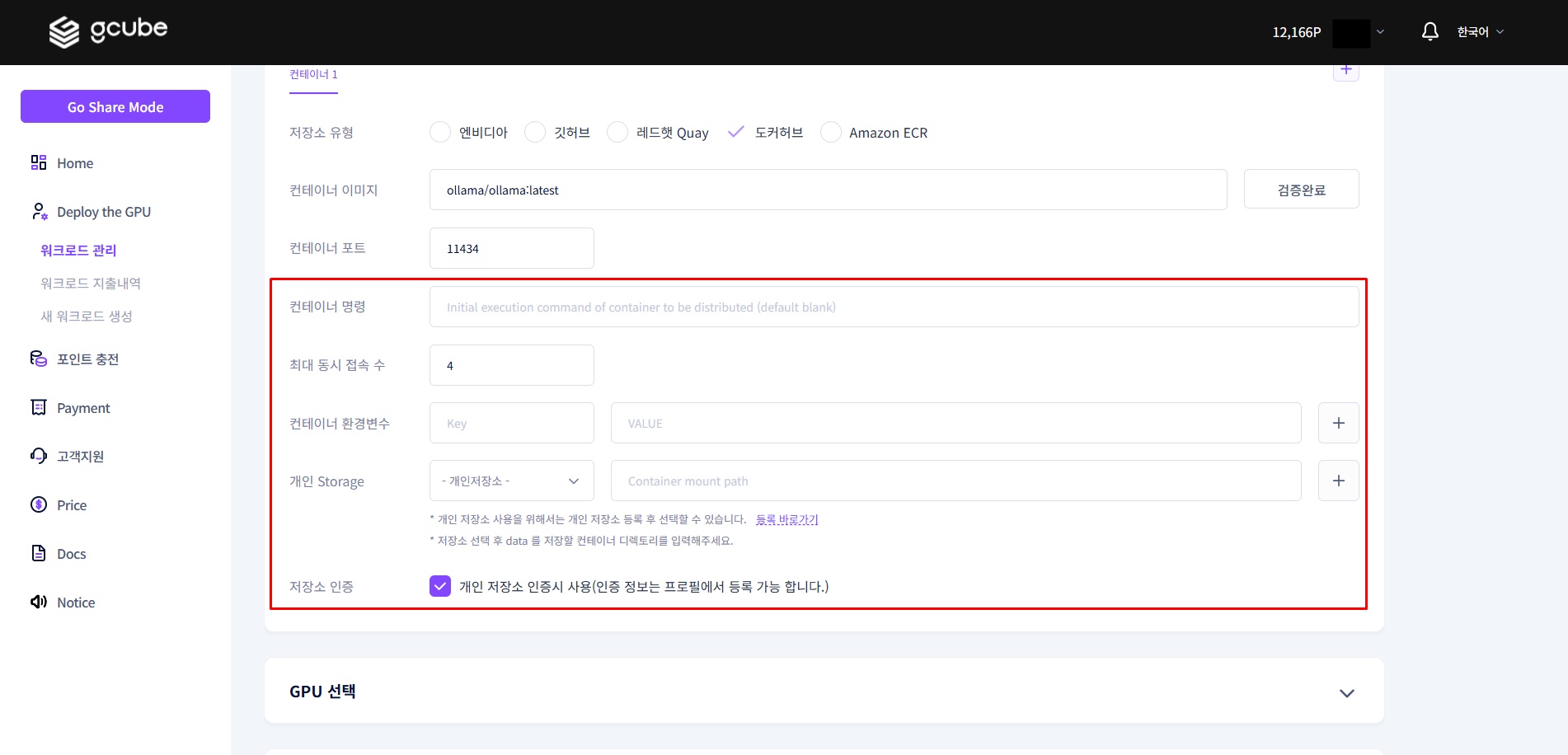
1-4. Options Settings
No additional options need to be configured for this guide. Refer to the table below for descriptions of each option.
| Option | Description |
|---|---|
| Container Command | Command to run when the container starts (Dockerfile CMD) |
| Max Concurrent Connections | Maximum number of users that can connect simultaneously |
| Container Environment Variables | Environment variables used inside the container (Dockerfile ENV) |
| Personal Storage | Dedicated storage that persists data even if the container restarts or is deleted |
| Registry Authentication | Authentication settings for accessing private container image registries |
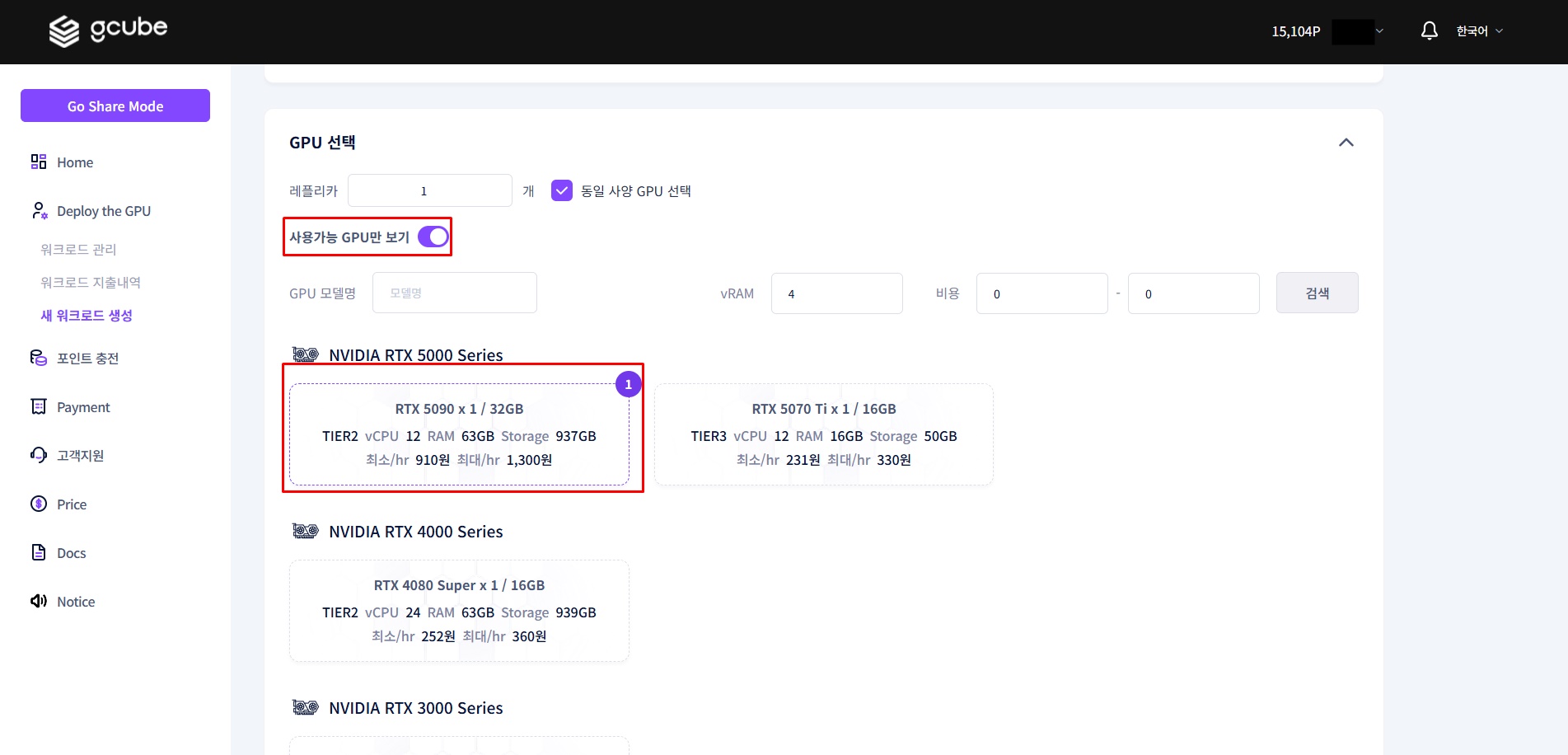
1-5. Select GPU Specs
Select the GPU specs that match your use case.
| Tier | Description |
|---|---|
| Tier 1 | High performance |
| Tier 2 | High reliability |
| Tier 3 | Individual users |
Recommendation
If this is your first time, select Tier 2 — RTX 5090. This guide's examples are based on that spec.
1-6. Final Confirmation and Deploy
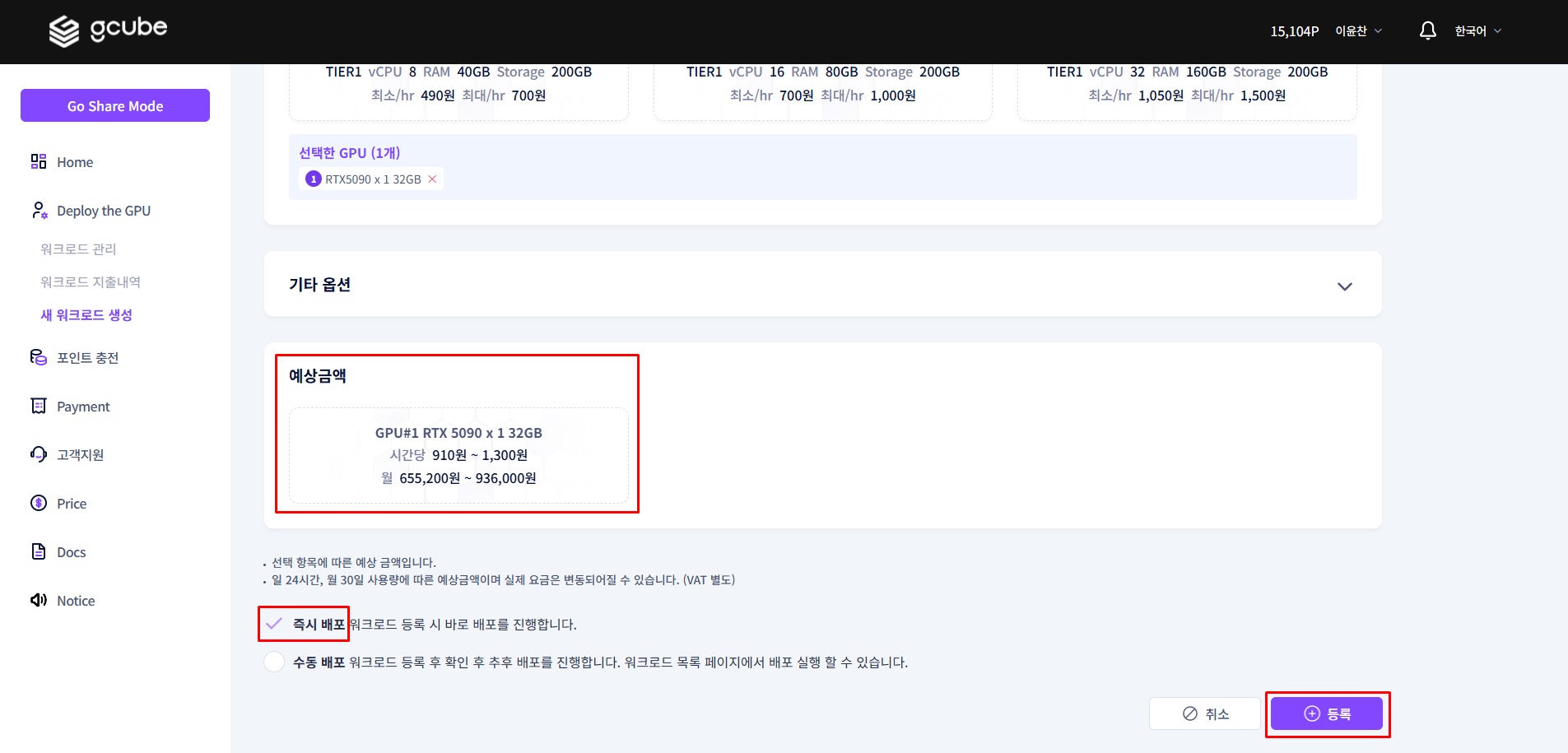
Check the estimated hourly cost for the selected specs.
Billing Information
The amount shown is the maximum hourly rate. You are billed proportionally to actual usage time, so always stop the workload after testing.
Select 'Deploy Immediately' to complete registration and deployment.
Step 2 — Run Llama3 Model
2-1. Check Created Workload
Click the workload name on the workload page to enter the detail screen.
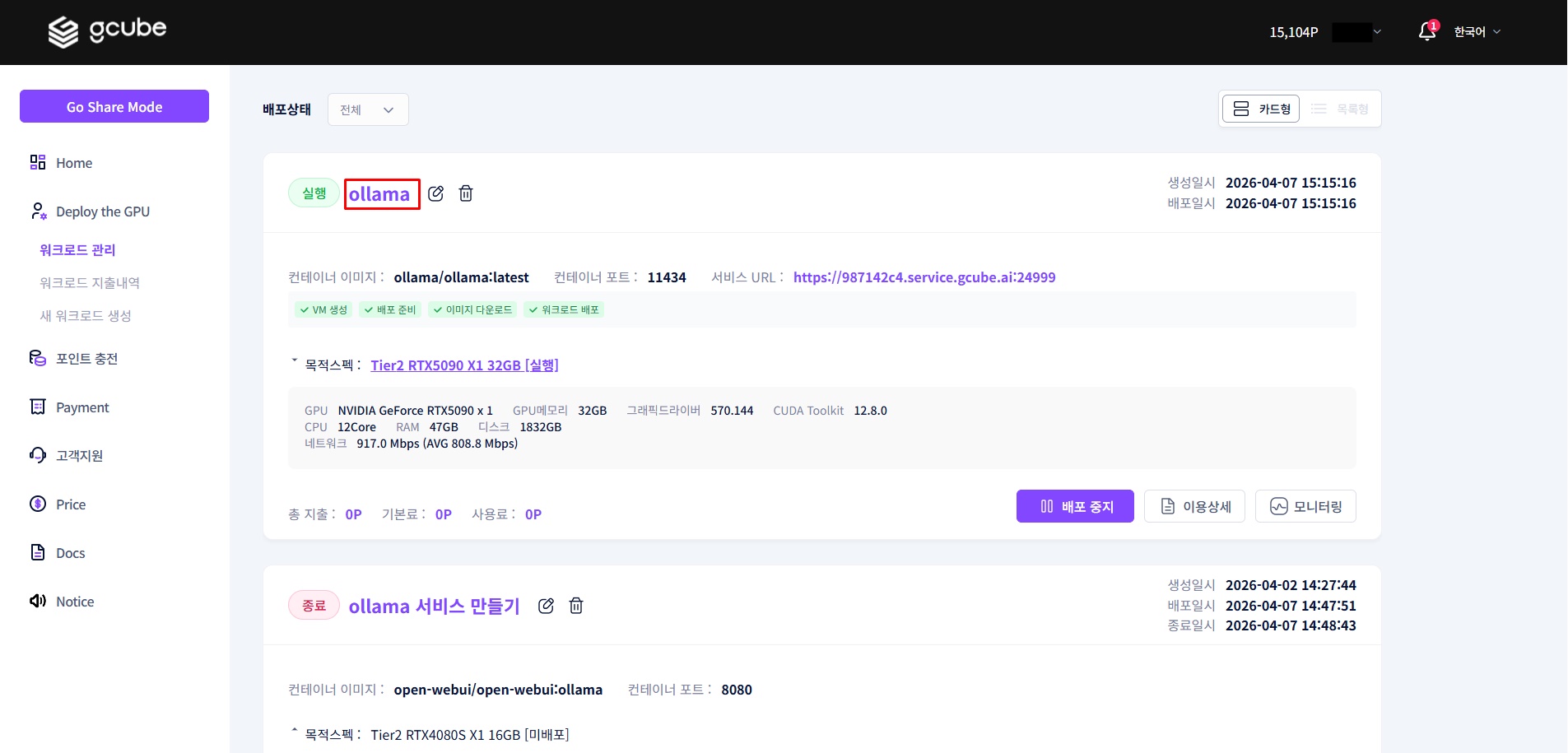
Key items available on the detail screen:
- Overview: Workload number, status, service URL, etc.
- Container: Image, port, creation/deploy/termination timestamps, etc.
- GPU Specs: GPU information, etc.
- Deployment Status: Pod status, container logs, terminal, SSH info, etc.
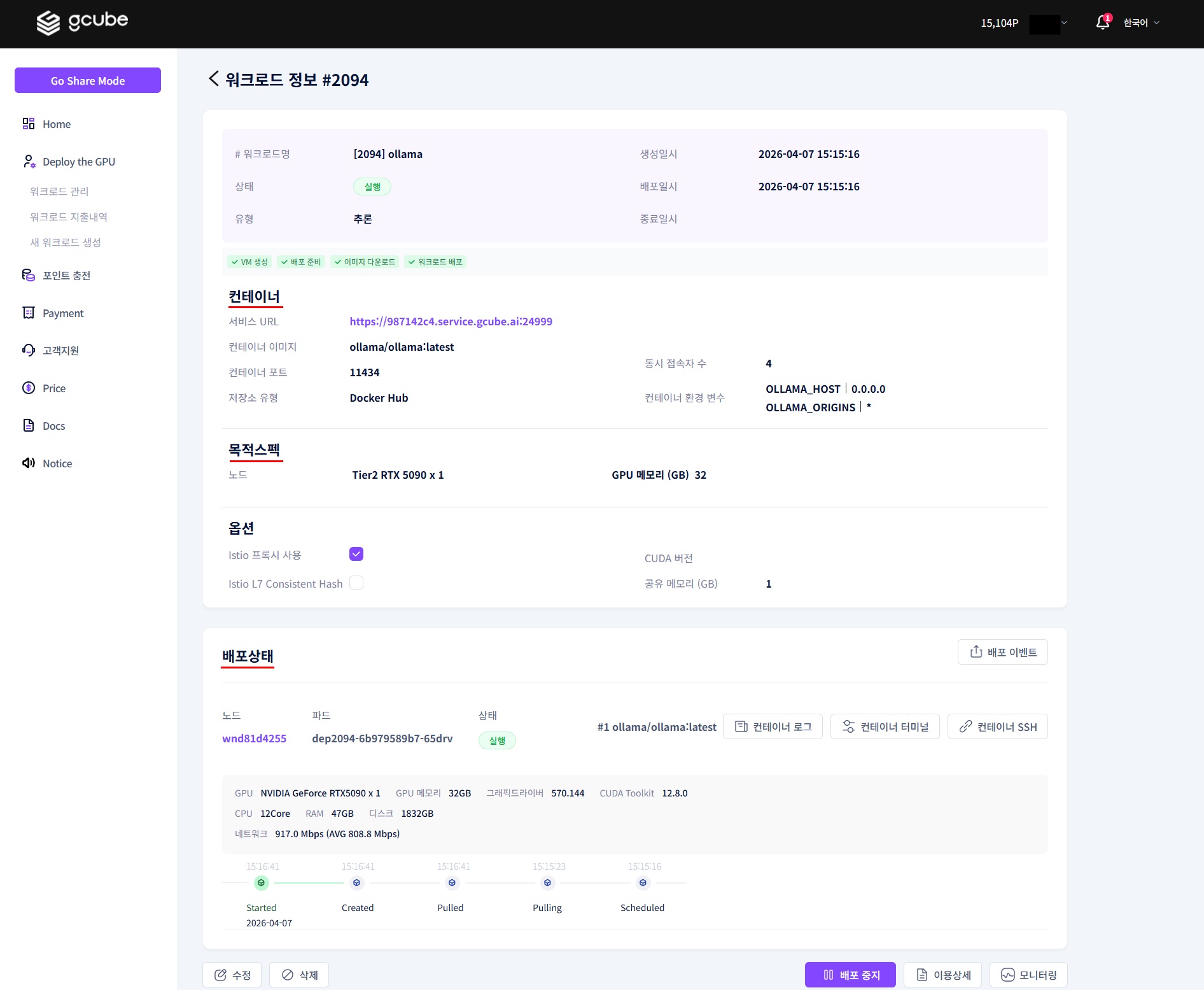
2-2. Check SSH Connection Info
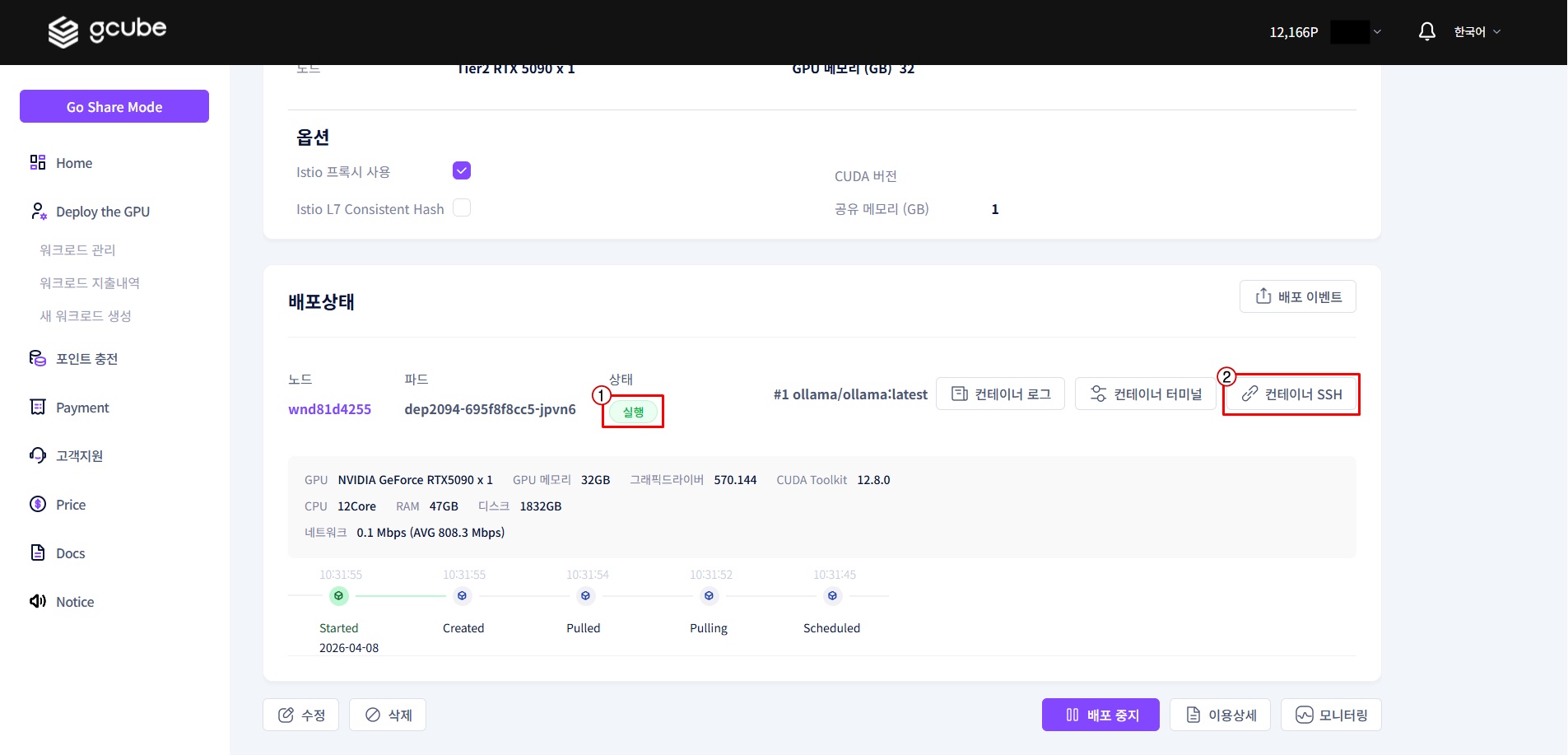
When the pod status shows ① 'Running', click ② Container SSH.
Tip
Immediately after deployment, it may take a few minutes for the pod to be ready. Wait until the status shows 'Running' before proceeding.
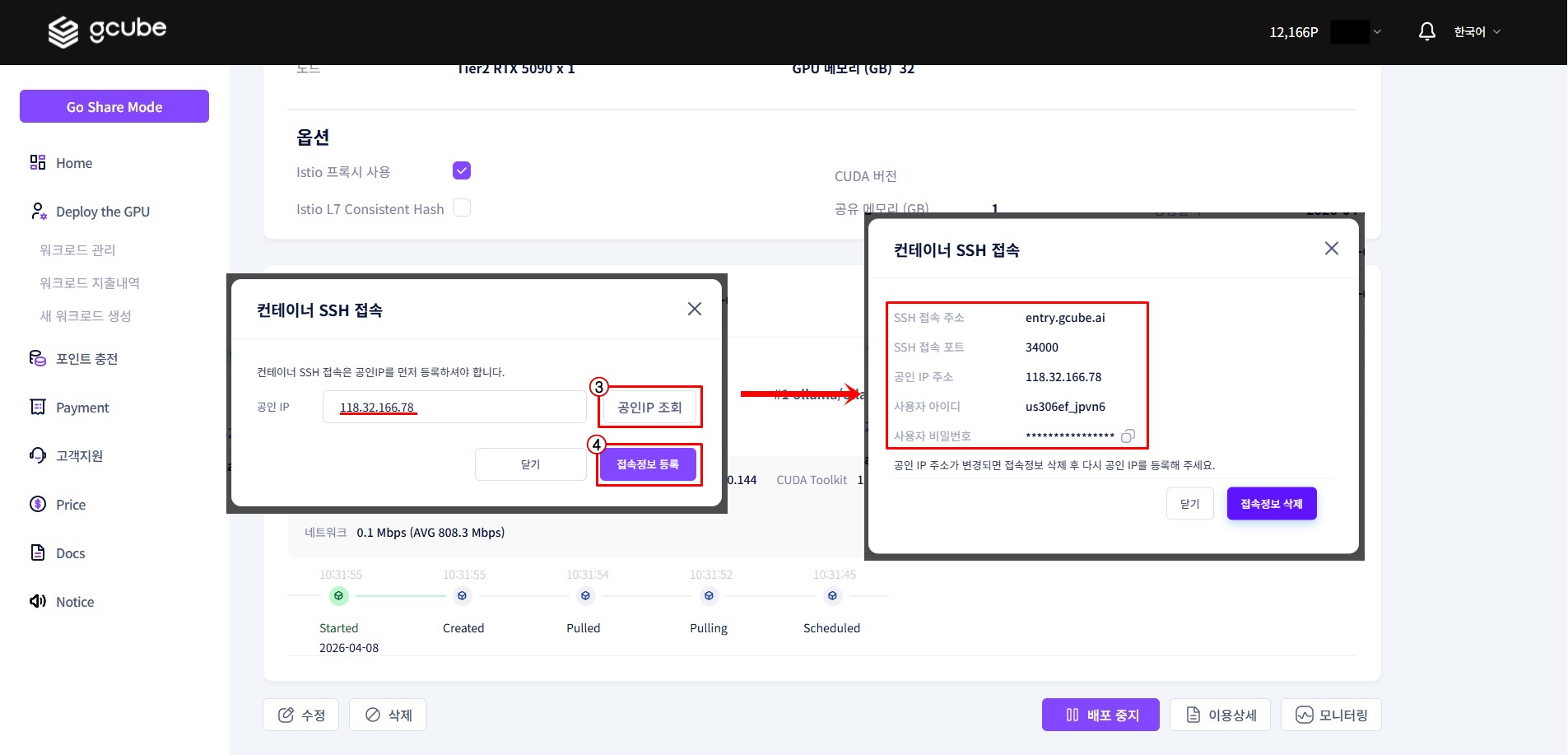
Look up ③ the public IP and ④ register the connection info to see the SSH connection details:
- IP Address
- Port
- Username
- Password
Note this information down. You will enter it into the terminal program in the next step.
2-3. Connect via PuTTY
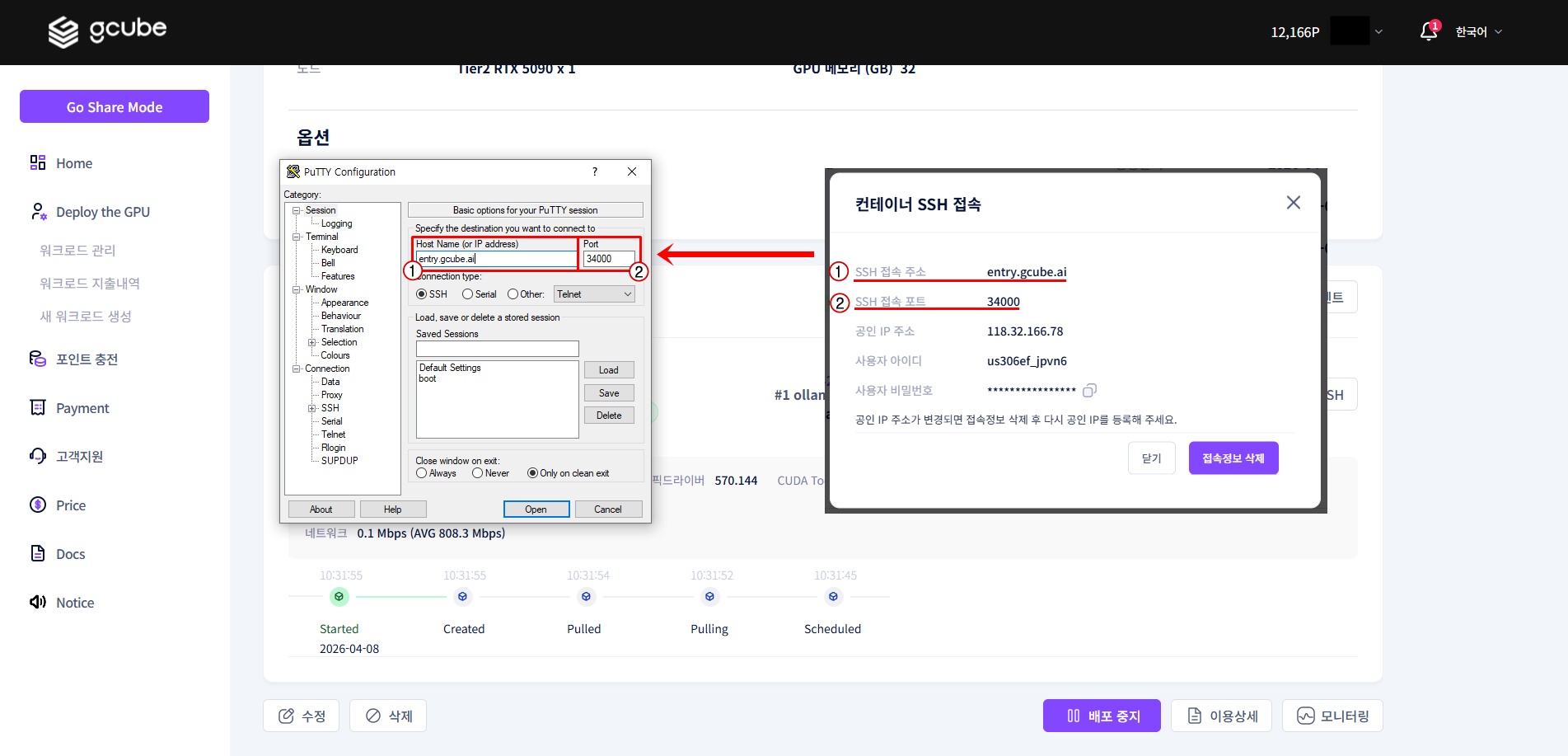
Launch PuTTY and enter the SSH connection information you noted above.
| No. | PuTTY Field | Value |
|---|---|---|
| 1 | Host Name | IP address from SSH connection info |
| 2 | Port | Port number from SSH connection info |
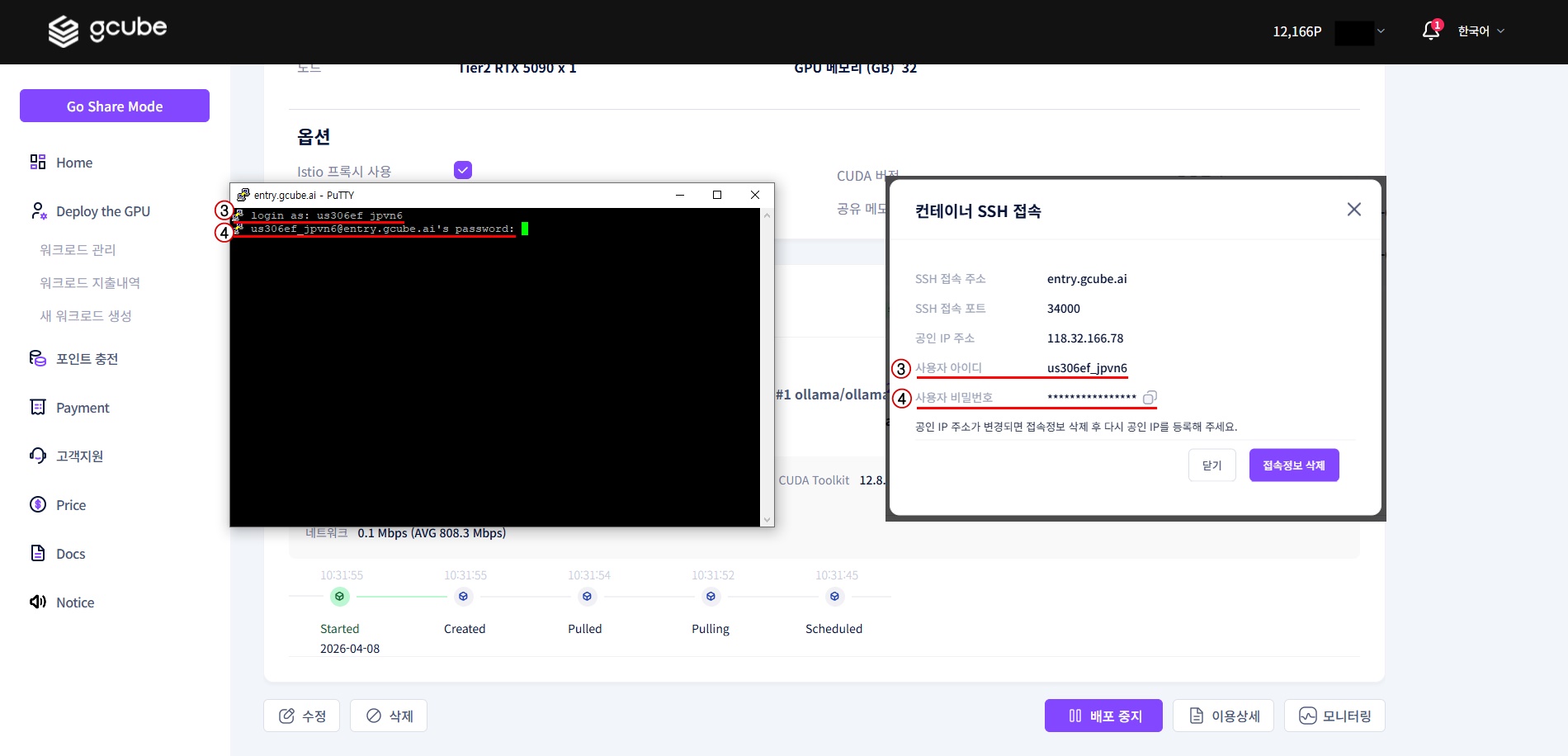
Click Open to launch the terminal window. Enter ③ the username and ④ the password in order to connect to the container.
2-4. Download and Run Llama3 Model
Enter the following command in the terminal. The model is approximately 4.7GB and may take a few minutes to download.
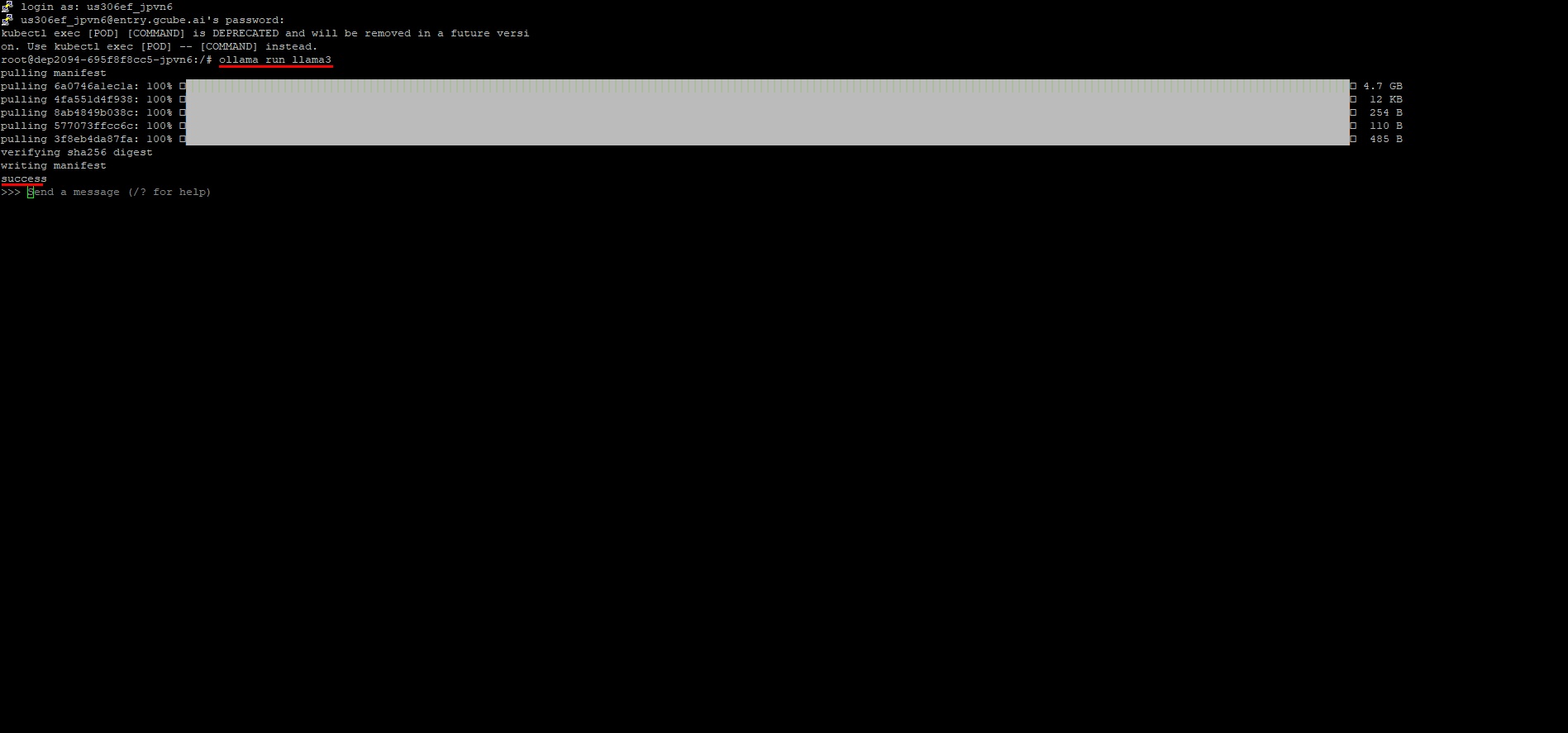
Once the download is complete, the model will start automatically and you can chat with the AI directly in the terminal.
Step 3 — Chat with Llama3
After running the model, type your question in the terminal and Llama3 will respond. You can ask in natural language just like with ChatGPT.
Usage Example
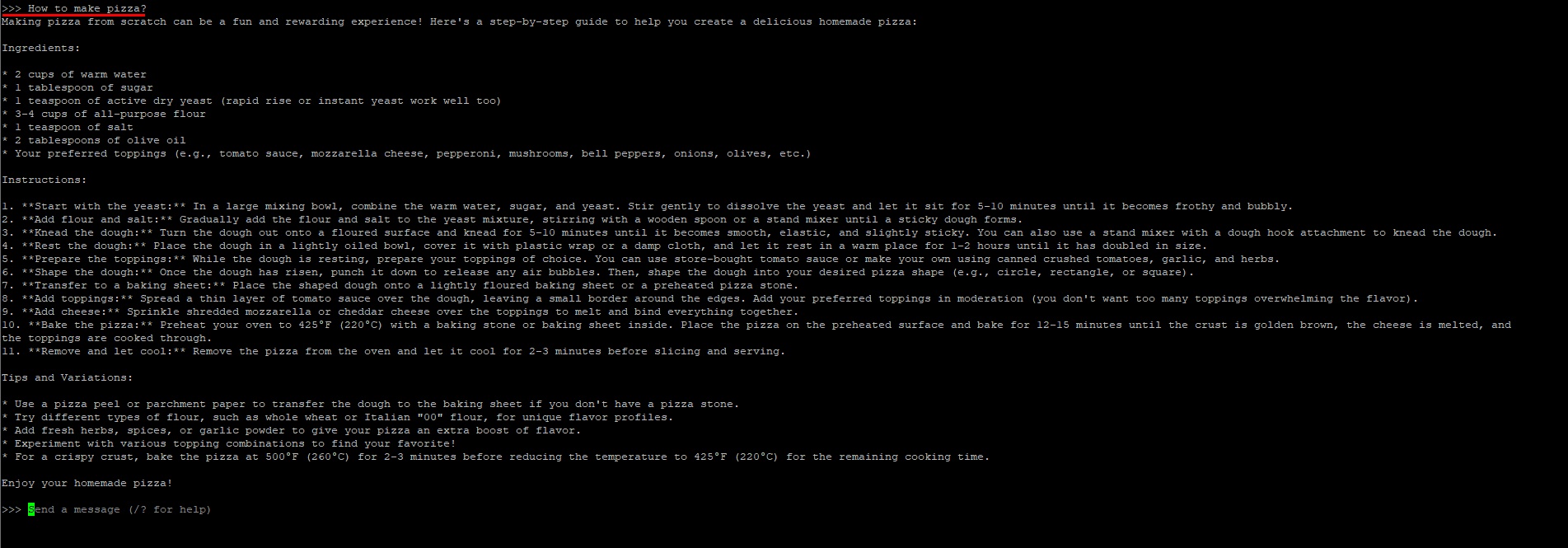
To end the conversation, enter the following command.
Step 4 — Stop and Delete Workload
Important
If you do not stop the workload, charges will continue to accrue even when not in use.
4-1. Stop Workload
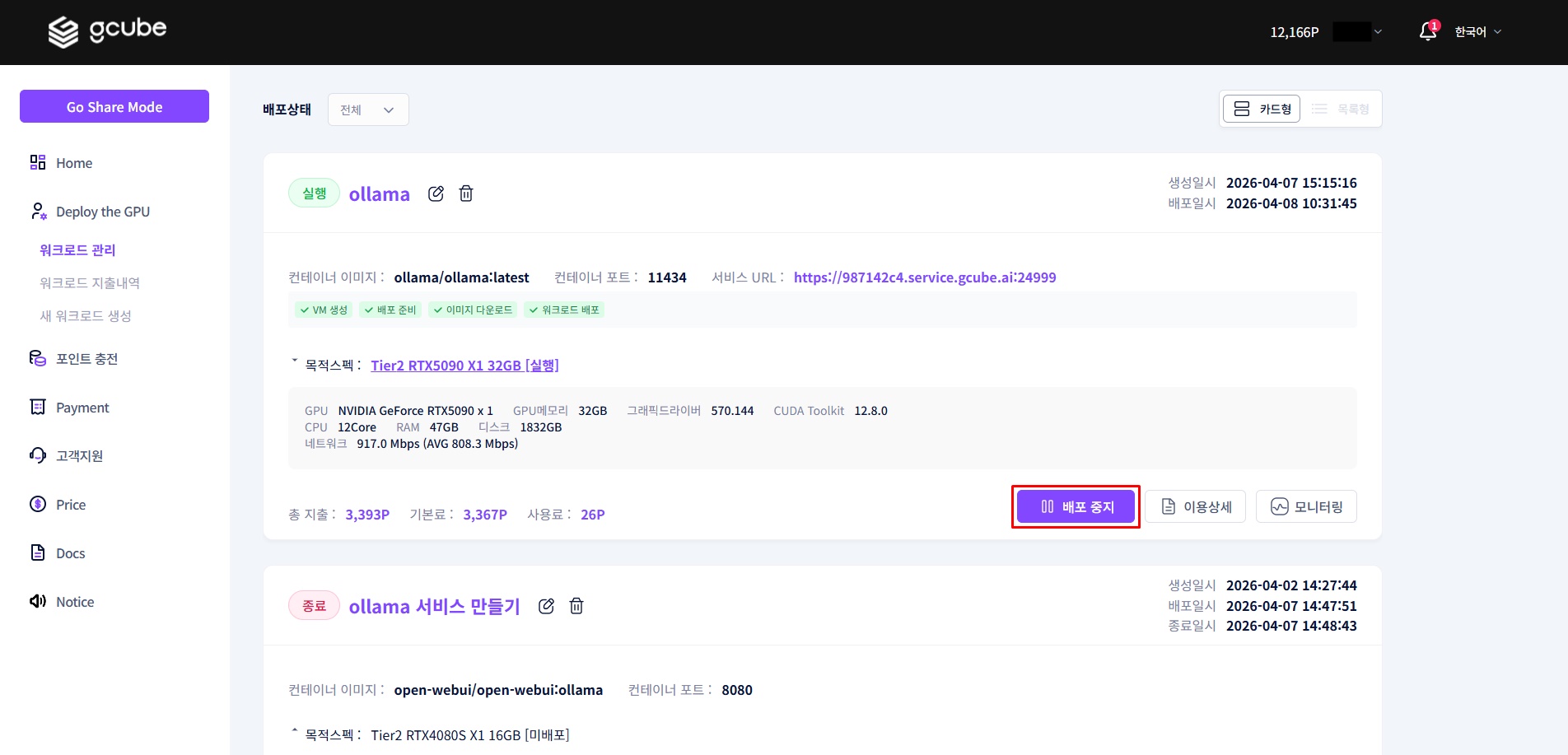
Click the "Stop Deployment" button for the running workload in workload management. When the status changes to 'Deployment Stopped', billing stops.
Tip
After stopping, you may need to re-download the model when restarting. If you use it frequently, consider keeping it running and deleting it when done instead of stopping.
4-2. Delete Workload
If you no longer need the workload, delete it from the workload list. Deleting removes all data inside the container (including downloaded models).
Troubleshooting (FAQ)
Q. The pod status is not changing to 'Running'.
Some preparation time is needed immediately after deployment. Try refreshing the page after a few minutes. If still not resolved, check the container logs in the Deployment Status tab.
Q. PuTTY connection is failing.
Check the following in order:
- Confirm the workload pod status is 'Running'
- Verify the IP address and Port number are entered correctly
- Re-check the connection info on the SSH info screen and try again
Q. Model download is too slow.
The Llama3 model is approximately 4.7GB. It may take time depending on network conditions. Do not close the terminal and wait until the download is complete.
Q. Do I need to reinstall the model after stopping and restarting the workload?
If you Stop the container and restart it, existing data may not be preserved. If you Delete it, you must re-download the model.